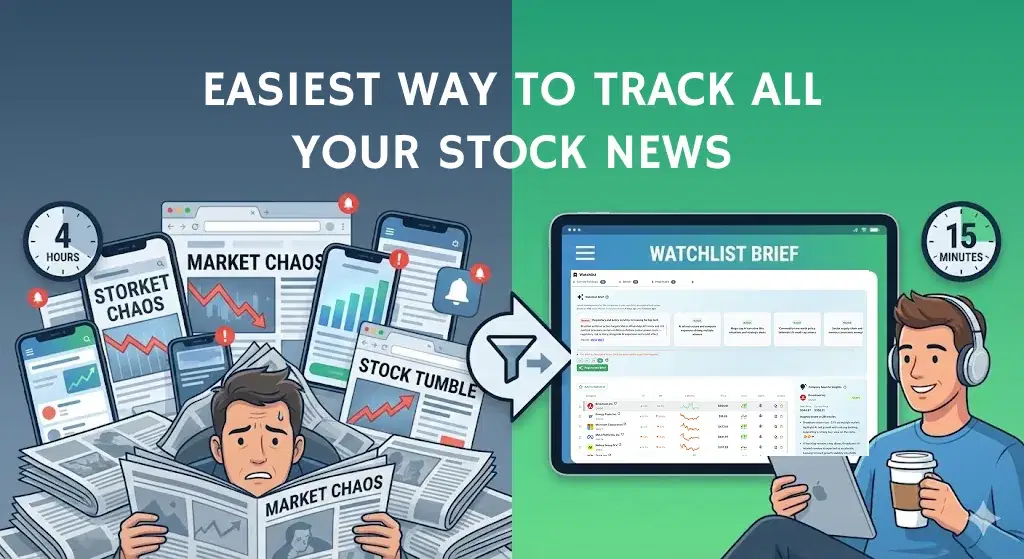

The Hidden Time Cost of Stock Research (And Why It Hurts Decision Quality)

Stock research isn’t hard—it’s inefficient. Discover why modern investors waste hours on information overload and how elite investors optimize time-to-insight.
Stock research feels productive.
You’re reading, analyzing, staying informed. It feels like work that should improve outcomes.
But for many investors, the reality is more subtle not to mention more costly.
The problem is not that stock research is hard. It’s that the modern research workflow is structurally inefficient, and most investors dramatically underestimate how much time and cognitive energy it consumes.
TLDR:
This article is not about tools, feeds, or news sources.
It is about research efficiency:
- why stock research takes so long,
- how cognitive overload quietly degrades decision quality,
- and why elite investors focus less on information access and more on time-to-insight.
The Invisible Time Tax of Investing
Most investors can tell you how much capital they have at risk.
Far fewer can tell you how much time they are spending to manage it.
Stock research rarely appears as a line item, yet it quietly absorbs evenings, weekends, and fragmented attention during the workday.
Because this time is spread across short sessions (five minutes here, ten minutes there) it often goes unnoticed.
But cumulatively, the cost is enormous.
Why Stock Research Takes Longer Than We Expect
The intuition is simple: more information should mean better decisions.
In practice, more information usually means more synthesis work, and synthesis is the slowest part of thinking.
Research Has Shifted From Scarcity to Overload
Historically, investors struggled to get information.
Today, the struggle is to: filter it → connect it → decide what actually matters.
The constraint is no longer access. It is processing capacity.
This article is not about where to find stock news or how to track updates more efficiently. It’s about why the act of researching stocks itself has become structurally inefficient.
Cognitive Load: The Silent Performance Killer
One of the least discussed aspects of investing is cognitive load.
Each additional input—article, opinion, data point—adds to the mental burden of decision-making.
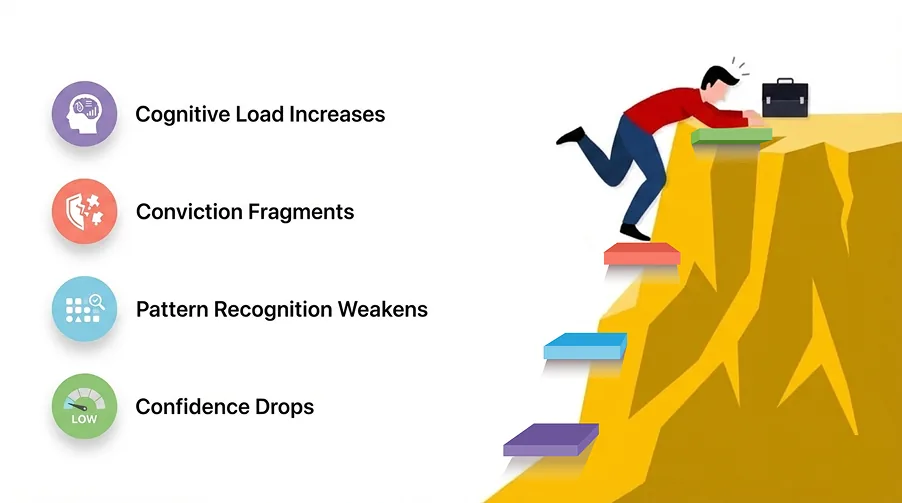
It becomes more and more apparent as cognitive load increases → pattern recognition weakens → conviction fragments → confidence drops
Investors often respond by reading more, when the real issue is that their mental stack is already full.
Behavioral decision-making research shows that increased cognitive load impairs deliberative and integrative reasoning, reducing the quality of complex judgments even when information is available.¹
Context Switching Is Where Efficiency Breaks Down
Stock research is rarely linear.
An investor might:
- read about one company,
- jump to a macro story,
- switch to a different sector,
- return to the original position with diminished context.
This constant context switching imposes a measurable cost.
Psychologically, it fragments attention. Economically, it increases time-to-insight.
Most research workflows are optimized for content discovery, not cognitive continuity.
You Are Your Own Bottleneck
Every serious investor relies on the same fragile system: their own ability to consume raw information and turn it into insight.
That system has hard limits.
Your edge depends on how much data you can personally read, interpret, cross-reference, and synthesize. Miss a document. Skim a paragraph. Defer a transcript. Trust the wrong summary. Each shortcut subtly degrades the quality of the decision on the other side.
And this isn’t about discipline alone. It’s about human constraints.
- What happens when you’re tired?
- When you don’t have time to read the full filing?
- When sourcing reliable information takes more effort than you can spare?
- When attention fades halfway through a long report?
Insight requires full engagement. But investors don’t operate at peak cognitive output all the time.
Synthesis is cognitively expensive work. It demands focus, context, and consistency. If any of those drop—even briefly—you risk missing a detail that actually mattered. Not because you’re careless, but because your brain is a variable input.
The uncomfortable truth is this: your research process scales only as far as your personal bandwidth allows.
When the volume of raw data exceeds what you can reliably process—day after day—you become the constraint. Not the data. Not the tools. You.
And once your own attention becomes the bottleneck, the risk isn’t just inefficiency. It’s blind spots.

Decision Fatigue and the Illusion of Being “Informed”
The more decisions an investor has to make in a day, the worse those decisions tend to become.
This is not a discipline problem. It is a neurological reality.
By the time many investors reach an actual portfolio decision, their mental energy has already been spent on sorting, filtering, then reconciling conflicting narratives.
Being informed is not the same as being decision-ready.
Time-to-Insight Matters More Than Volume of Insight
Elite investors rarely aim to know everything.
They aim to recognize changes quickly, understand implications clearly, all the while preserving mental bandwidth for judgment.
This is why time-to-insight is a more useful metric than hours spent researching.
A faster, cleaner understanding beats a deeper but slower one.
The Opportunity Cost of Inefficient Research
Every hour spent synthesizing redundant information has an opportunity cost.
Just think, all that time could otherwise be used for identifying other undervalued stocks, going through an earnings report, or even spending more time with family.
Inefficient research does not just waste time—it reallocates attention away from the highest-leverage thinking investors can do.
Why “More Discipline” Is the Wrong Fix
When investors feel overwhelmed, the typical advice is:
- be more selective,
- read less,
- stay focused.
But this frames the problem as a behavioral failure.
In reality, the issue is workflow design.
No amount of discipline can overcome a system that forces humans to perform large-scale synthesis manually, day after day.
How Professional Investors Think About Research Workflows
Professional investors rarely optimize for:
- reading speed
- source count
- or headline coverage
They optimize for:
- clarity
- consistency
- and reduced cognitive friction
Their workflows are designed to minimize redundant processing, context switching while never missing the beat on important shifts in the market.
This is not about working harder. It is about reducing friction in thinking.
Manual vs Automated Research: A Structural Shift
At a category level, the biggest shift in modern investing is not better data.
It is delegating synthesis.
Automation is not valuable because it is faster. It is valuable because it:
- Removes repetitive cognitive labor,
- Standardizes interpretation,
- Frees human judgment for higher-order decisions.
This is the difference between doing research and designing a research system.
Why This Matters More as Portfolios Grow
As portfolios expand, research workload grows non-linearly.
Each additional holding increases information inflow that will further require to be synthesized. All the while monitoring the events across all other holdings.
Without structural changes, research time quickly becomes unsustainable.
This is why efficiency is not optional—it is inevitable.
The Direction Research Is Moving
Stock research is evolving from:
“How do I find the right information?”
to:
“How do I process information with minimal cognitive waste?”
This shift favors:
- summarized insights over raw inputs,
- thematic understanding over fragmented updates,
- and systems over habits.
A Note on Research Acceleration Layers
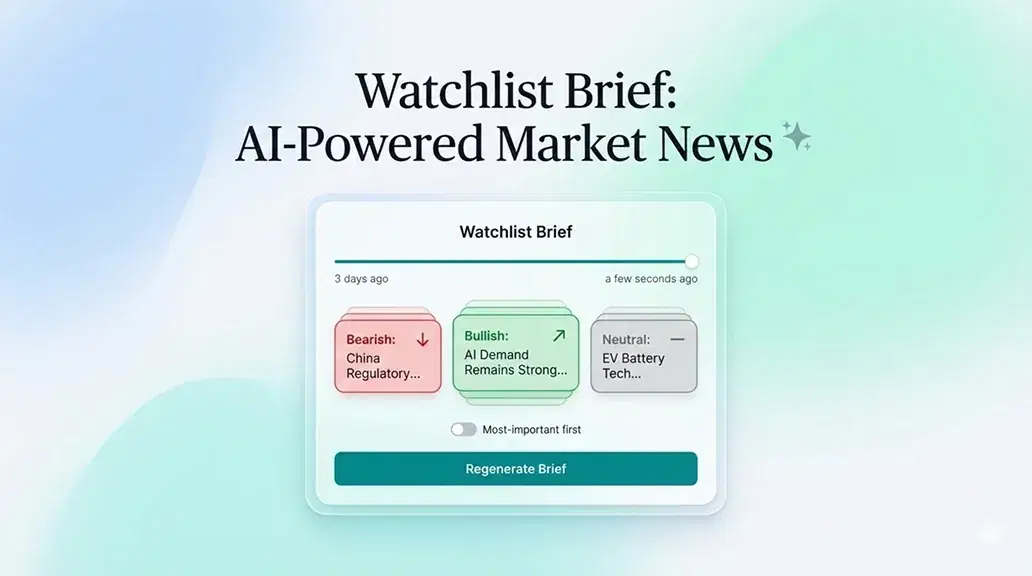
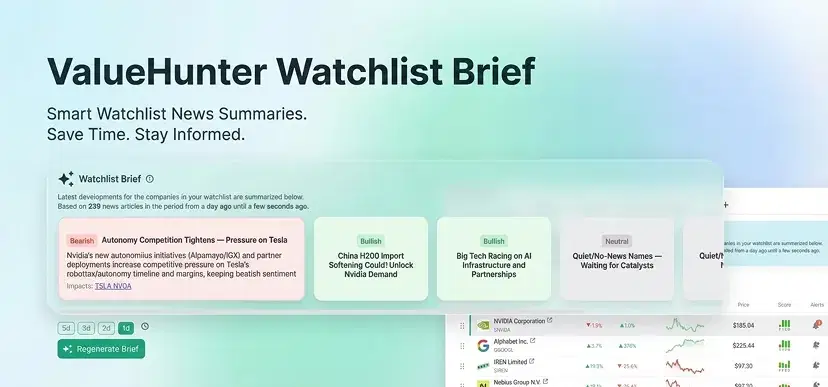
Some investors are beginning to use research acceleration layers—systems that reduce manual synthesis by compressing large volumes of information into coherent insight.
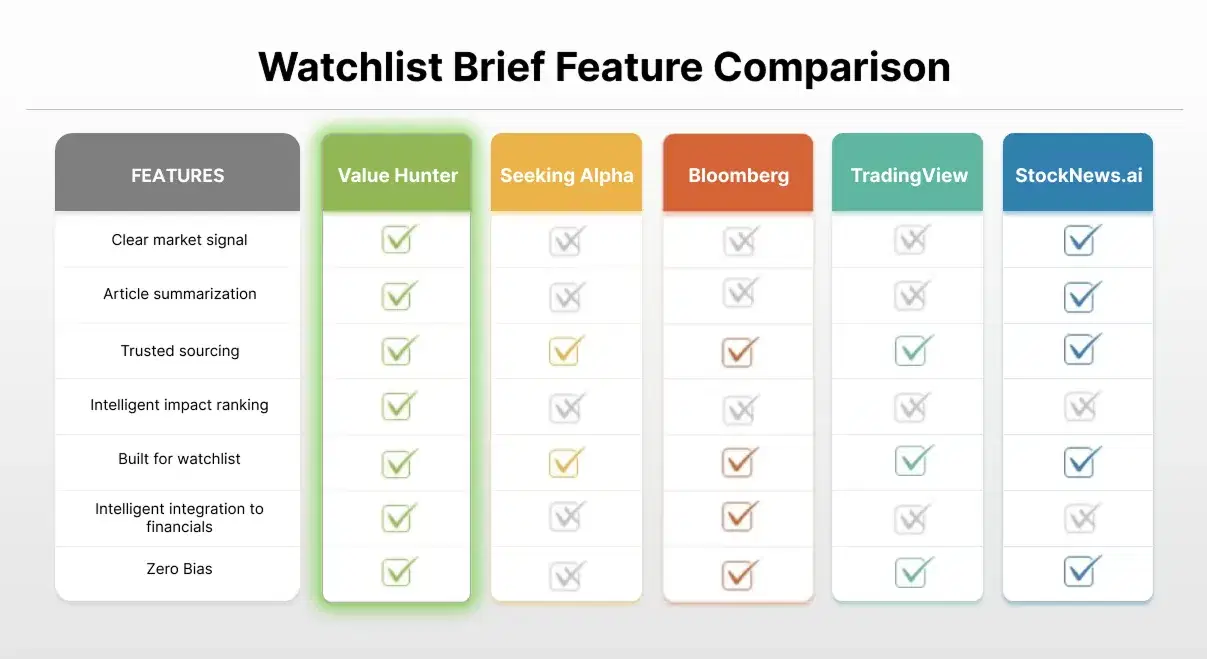
Tools like Watchlist Brief by Value Hunter are one example of this broader category, not because of any single feature, but because they shift the investor’s role from processing information to interpreting outcomes.
The key point is not the tool. It is the workflow philosophy behind it.
Final Thought: Research Efficiency Is a Competitive Advantage
Markets do not reward the investor who reads the most.
They reward the investor who:
- Understands changes fastest
- Preserves clarity under complexity
- Makes decisions with a fresh, focused mind
Stock research will always require effort.
But how much time it should take is a question more investors need to ask.
Because as we all know, "Time is money"